
Making a listing impression
Types of product knowledge
Offer practical experiences
Making a listing impression
Types of product knowledge
Offer practical experiences
Making a listing impression
Types of product knowledge
Offer practical experiences
Making a listing impression
Types of product knowledge
Offer practical experiences
Making a listing impression
Types of product knowledge
Offer practical experiences
Making a listing impression
Types of product knowledge
Offer practical experiences
Limited-time savings
Value-added service bundles
Suitable for new projects
Limited-time savings
Value-added service bundles
Suitable for new projects
Limited-time savings
Value-added service bundles
Suitable for new projects
Limited-time savings
Value-added service bundles
Suitable for new projects
 EupeProperty Development – Residential & Sustainable CommunitiesEupe Corporation is a Malaysian property developer behind award-winning residential projects and sustainable communities.
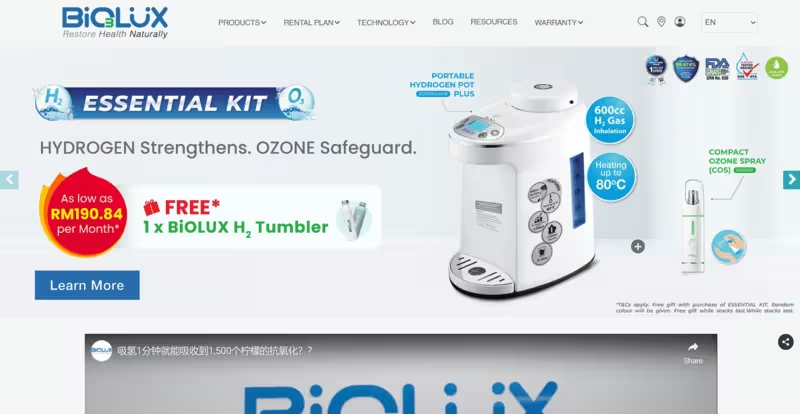 Biolux AsiaHealth Technology – Ozone & Hydrogen Hygiene DevicesBiolux offers ozone disinfection systems, hydrogen-based wellness devices, and sanitation solutions. View archive





Discover how we help brands build impactful digital experiences through strategy, design and development.
We’ll run a structured, surface-level website security health check to help you identify common
risks before they develop into business-impacting issues. If deeper audits or compliance-level protection are required, we’ll connect you with our certified cybersecurity partner.

We are a digital solutions provider that designs, builds, hosts, and maintains the websites and web applications businesses rely on every day.
From web design and custom web app development to hosting and SEO services, we manage the full digital lifecycle. When certified cybersecurity firms conduct VAPT (Vulnerability Assessment & Penetration Testing), we are often responsible for implementing the remediation and patching the identified vulnerabilities.
Over time, we’ve observed that most security issues do not begin with sophisticated attacks. They begin with:

CMS updates postponed due to fear of breaking the site
Plugins added without structured review
Security configurations left unchanged for years
Expired SSL certificates unnoticed
Domains flagged without internal awareness

This health check exists to provide clarity — before those small gaps become operational problems.
If certified penetration testing, regulatory audits, or formal compliance assessments are required, we collaborate with a trusted cybersecurity partner.


Website security is not only a technical concern. It affects:

Search Rankings

Email Deliverability

Brand Credibility

Customer Confidence

Recovery cost and operational downtime
Many businesses only discover issues after:
Traffic drops unexpectedly
Customers report suspicious redirects
Emails begin landing in spam
Browsers display warning messages
By that point, remediation is reactive rather than preventive.

This is not a penetration test.
It is a structured surface-level review designed to identify visible configuration gaps and exposure risks.

Certificate validity, expiration status, and secure connection integrity.

Presence and configuration of HSTS, Content Security Policy, X-Frame-Options, and related protective headers.

Potential disclosure of sensitive directories or administrative paths.

SPF, DKIM (Selector Needed), and DMARC configuration consistency to reduce spoofing risk.

Identification of detectable perimeter protection layers.

Review against publicly available threat intelligence sources, including Google Safe Browsing and recognized blocklist databases.

Publicly exposed CMS indicators and detectable outdated signals.
You will receive a concise, presentation-style PDF report that includes:

Structured summary of findings

Risk indicators (Green / Yellow / Red)

Clear, plain-language explanations

Observations relevant to business impact

Suggested next-step considerations
For certified audits or compliance-level assessments, we coordinate with our cybersecurity partner.

This report is designed for internal review and decision-making.
Remediation is not included in this free
health check.
Implementation support can be arranged separately if needed.
This health check is suitable for:
SMEs operating WordPress or custom CMS websites
Businesses that have not conducted a recent security review
Companies unsure about their current configuration posture
Marketing or operations teams overseeing website performance
Organizations without structured monitoring processes
If your website has not been formally reviewed in the past 12 months, this check provides a responsible starting point.
Security failures rarely announce themselves in advance.
A short, structured review today can prevent unnecessary disruption tomorrow.
Free. Non-intrusive. Clear in scope.