
Making a listing impression
Types of product knowledge
Offer practical experiences
Making a listing impression
Types of product knowledge
Offer practical experiences
Making a listing impression
Types of product knowledge
Offer practical experiences
Making a listing impression
Types of product knowledge
Offer practical experiences
Making a listing impression
Types of product knowledge
Offer practical experiences
Making a listing impression
Types of product knowledge
Offer practical experiences
Limited-time savings
Value-added service bundles
Suitable for new projects
Limited-time savings
Value-added service bundles
Suitable for new projects
Limited-time savings
Value-added service bundles
Suitable for new projects
Limited-time savings
Value-added service bundles
Suitable for new projects
 EupeProperty Development – Residential & Sustainable CommunitiesEupe Corporation is a Malaysian property developer behind award-winning residential projects and sustainable communities.
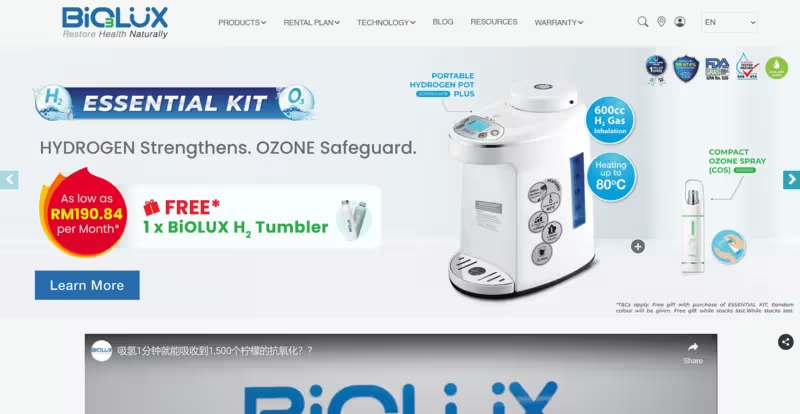 Biolux AsiaHealth Technology – Ozone & Hydrogen Hygiene DevicesBiolux offers ozone disinfection systems, hydrogen-based wellness devices, and sanitation solutions. View archive





Discover how we help brands build impactful digital experiences through strategy, design and development.
Don’t just recover from attacks, harden your site to stop them from happening in the first place.
Website attacks rarely happen because attackers are sophisticated. Most incidents occur because
websites are left exposed through weak configurations, outdated software, excessive permissions, or
missing security safeguards.
Website security hardening helps reduce those risks before attackers exploit them. Instead of waiting
for malware infections, defacement, spam abuse, or data exposure, security hardening strengthens your
website’s configuration and reduces common vulnerabilities.
At Web Temple, we provide website security hardening services for business websites, CMS platforms,
and custom web applications, helping organizations improve their security posture and reduce the risk
of preventable attacks.

Many websites are compromised not because they are poorly built, but because security hardening was
never implemented properly. Weak configurations, outdated components, and missing protection
mechanisms create opportunities for attackers.
During real-world security assessments, these are the most common issues we encounter.

Unpatched software is one of the most common entry points for attackers. Outdated CMS components, plugins, themes, or libraries may expose websites to known vulnerabilities..

Poor user role management and excessive administrative permissions increase the risk of unauthorized access and misuse.

Improper server, CMS, or application configurations can expose sensitive areas of your website and allow attackers to exploit known weaknesses.

Admin panels and login portals are common targets for automated attacks when proper protection mechanisms are not implemented.

Forms, upload functions, and search fields can become attack vectors when input validation and sanitization are not properly implemented.

Without proper logging and monitoring, suspicious activities and attack attempts may go unnoticed until damage has already occurred.
Without proper validation, access control, and security configurations, websites and web applications may be exposed to common vulnerabilities including:

Injection attacks (SQL, command, LDAP)
Broken access control
Cross-site scripting (XSS)
Security misconfiguration
Insecure deserialization
Insufficient logging and monitoring
These vulnerabilities align with widely recognized OWASP Top 10 web application security risks, and can affect CMS-based websites, business websites, portals, and custom web applications.
Web Temple’s Website Security Hardening service focuses on strengthening website and application security by addressing common vulnerabilities, improving configurations, tightening access controls, and applying industry-recognized hardening practices.
This service is not a replacement for certified cybersecurity audits, vulnerability assessments, or penetration tests, and Web Temple does not act as a certified audit body.
For mission-critical websites or systems operating in financial, healthcare, government, or other regulated sectors, certified audits or penetration tests may be legally required. These help organizations meet compliance standards such as ISO 27001, PCI-DSS, PDPA, or other regulatory frameworks.
If your business requires certified testing, compliance reporting, or regulatory-grade security validation, we can connect you with our certified cybersecurity partners who perform independent audits and penetration testing.
Already have a certified audit or penetration test report? Web Temple can help interpret the findings and implement the recommended technical hardening and remediation measures, ensuring the vulnerabilities are addressed efficiently and responsibly.
A business website is often connected to your brand reputation, search visibility, customer trust, and
daily business operations. When a website becomes compromised, the consequences can include
malware infections, spam abuse, SEO penalties, data exposure, website downtime, and damage to
customer confidence.
Website security hardening helps reduce these risks by strengthening configurations, tightening access
control, removing unnecessary exposure points, and improving the overall security posture of your
website.
For businesses that rely on their websites for marketing, sales, or customer engagement, proactive
website security hardening is an essential safeguard.